Taxes included.
Hesperis matronalis 'Purple' Sweet Rocket / Dame's Violet 'Purple'
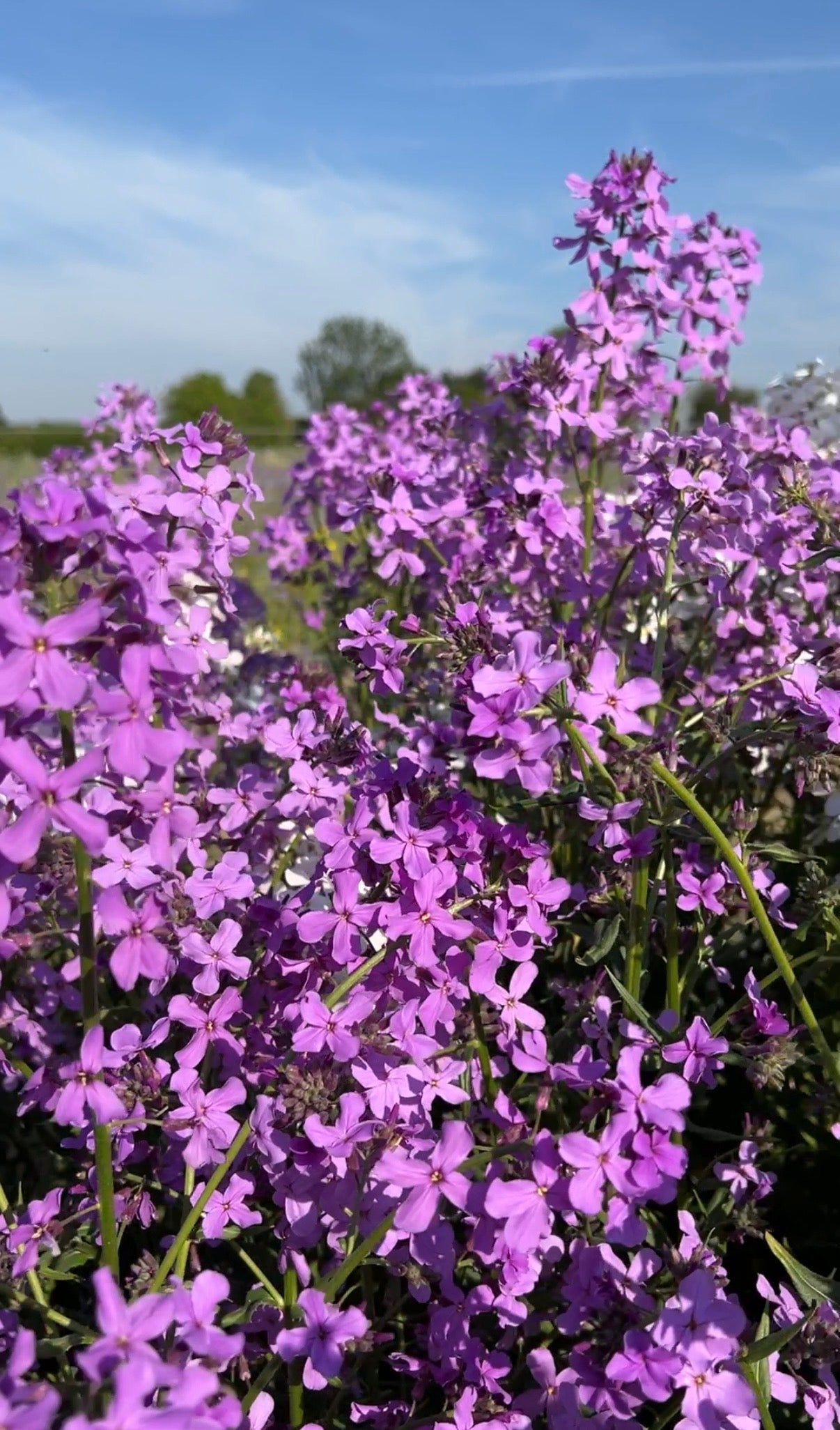
The classic violet-purple form of the great evening flower — tall 75–90cm branching stems clothed in loose clusters of four-petalled flowers in rich velvety violet-purple, releasing a powerful sweet violet-and-clove fragrance as darkness falls. Hesperis 'Purple' is the cottage garden classic that brings dusk-scented romance to shaded borders and serves as the preferred larval food plant for the Orange Tip butterfly.
This is the iconic form of Sweet Rocket — the variety that has filled English cottage gardens with evening fragrance for centuries. The rich vibrant violet-purple flowers are beautiful during the day but transform at dusk when the powerful sweet scent fills the surrounding air. The fragrance has a particular depth — violets and cloves combined — that few other plants can match, and the timing (evening release) is biologically tuned to attract night-flying moths. Hardy biennial (H7) following the two-year rhythm: rosette in Year 1, flowering glory in Year 2, then dies (but self-seeds reliably for permanent colonies). RHS Plants for Pollinators recognised. Preferred larval food plant for the Orange Tip butterfly — making 'Purple' Hesperis one of the most ecologically valuable plants in any wildlife cottage garden.
A note on growing
Sow direct outdoors May–July (or in modules indoors at 15–18°C). Cover seeds lightly with 3–5mm fine soil. Germination 14–21 days. Move plants to their final positions in October — partial shade or sun in moist humus-rich soil. Hesperis 'Purple' is genuinely most reliable in partial shade where soil moisture stays consistent through summer. The wild form grows along damp woodland edges and hedgerows — replicating these conditions in the garden gives the best results.
Cutting tip: cut when approximately one-quarter of the florets on each stem are open with the rest still in bud — the stem continues opening in the vase over several days. Re-cut stems at an angle and place immediately in deep water. Strip leaves below the waterline.
Self-seeding management: Hesperis self-seeds prolifically in suitable conditions — so prolifically that if allowed to set seed unrestricted in a small garden, it can become overwhelming. In small spaces, deadhead a proportion of plants after flowering to control spread. In larger gardens and woodland-edge plantings, let the colony establish naturally.
About Cabbage White caterpillars: as a Brassicaceae member, Hesperis can be targeted by Cabbage White butterfly caterpillars in late summer — check leaf undersides from July and hand-remove if needed.
Where it shines
In dusk-scented seating areas — plant near benches, patios or open windows where the evening fragrance can drift indoors. In shaded woodland borders. As a self-seeding informal colony plant. In wildlife gardens where the Orange Tip butterfly larval value is genuinely important. As a cut flower for romantic, slightly wild cottage arrangements.
Plant alongside
For the classical complementary colour pairing, combine 'Purple' Hesperis with Geum 'Lady Stratheden' (yellow) and Foxglove 'Primrose Yellow' — yellow and purple are complementary colours that intensify each other, and all three flower simultaneously in May–July. For an all-shade Brassica family combination, pair with Honesty (Lunaria) for the classic biennial partnership. For a "moon garden" pure-white-and-purple scheme, combine with Hesperis 'White'.