Radish China Rose
Radish China Rose
Radish 'China Rose' Microgreens Seeds
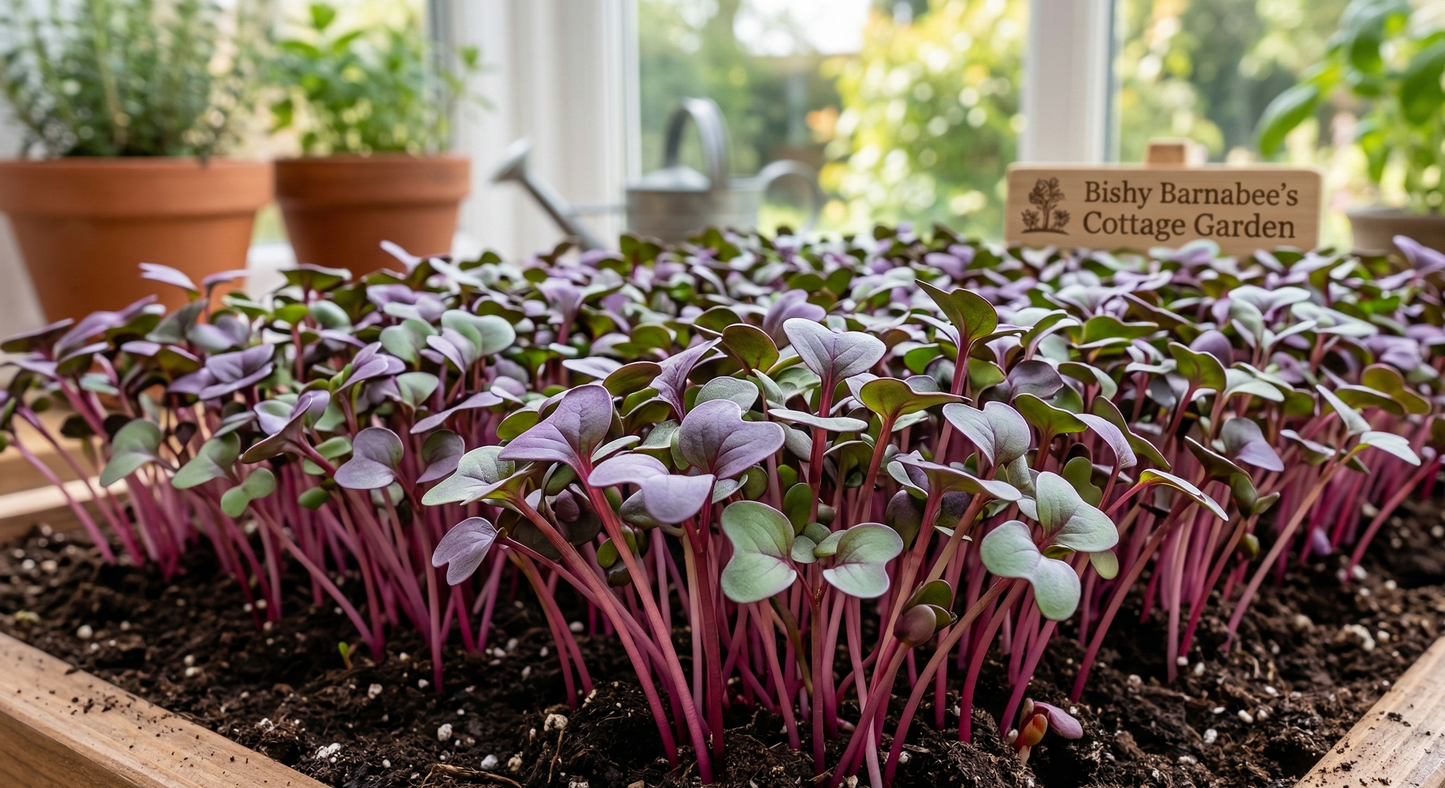
The elegant, heritage radish microgreen — long, blush-pink stems and vivid green leaves with a crisp, pleasantly peppery warmth that is gentler and more refined than Rambo. A Victorian kitchen garden variety that looks as beautiful in a tray as it does on a plate.
'China Rose' is one of the oldest radish varieties — a Victorian heritage type originally grown as a full-sized winter radish whose elongated, rose-pink roots were a staple of the 19th-century British kitchen garden. As a microgreen it is quite distinct from the vivid, intense 'Rambo' variety: the stems are longer, more slender, and a softer, blush rose-pink rather than Rambo's saturated deep purple, the leaves are slightly broader and a rich, glossy emerald, and the flavour is a pleasantly warm, moderately peppery heat — present and characterful but never aggressive. It is the radish microgreen for those who want the beauty and peppery quality of the genus without the full intensity of Rambo's heat.
The combination of long blush-pink stems and vivid green leaves is, in its quiet way, quite extraordinarily beautiful in a tray — the kind of thing that looks like a deliberate design choice rather than something that grew from a packet of seeds in a week. On a plate, the effect is equally striking: piled over pale, creamy dishes, the rose-pink stems catch the light and the green leaves frame them with a freshness that no supermarket microgreen can replicate. 'China Rose' is the microgreen that makes the windowsill itself worth looking at while the tray is growing, and the plate worth photographing when it arrives at the table.
🌿 Understanding the Crop
Raphanus sativus 'China Rose' is a Half-Hardy Annual heirloom radish variety with a cultivation history stretching back to at least the mid-19th century in Britain, where it was grown as a full-sized winter radish in kitchen gardens throughout the Victorian era. As a microgreen variety it has been rediscovered and embraced by chefs and home growers for the combination of qualities that make it distinctive from modern radish microgreen varieties — longer, more elegant stems, a softer rose-pink colouring, and a more moderate, nuanced heat that is easier to pair with delicate dishes.
China Rose vs Rambo — The Differences That Matter:
🌸 China Rose
Blush rose-pink stems — softer, longer, more elegant. Moderate, pleasant peppery warmth. Broader, glossy leaves. Heritage Victorian variety. Pairs with delicate dishes — soft cheese, fish, eggs, salads. The refined radish microgreen.
🌶️ Rambo
Deep violet-purple stems — vivid, saturated, intense. Bold, fiery isothiocyanate heat. Finer leaves. Modern variety bred for colour. Pairs with rich, fatty dishes — steak, avocado, cured meats. The dramatic radish microgreen.
The Heritage Advantage: As an open-pollinated heritage variety, 'China Rose' seeds can be saved from the finest microgreen trays and regrown the following season — the plants breed true and maintain their characteristic colouring and flavour across generations. This connection to a long cultivation history gives the variety a particular resonance for gardeners interested in seed heritage and in maintaining the diversity of the kitchen garden's botanical past.
The Colour Source: The rose-pink colouring of 'China Rose' stems comes from betacyanin pigments — the same betalain group responsible for the deep crimson of Boltardy beetroot and the candy-stripe rings of Chioggia. Unlike the anthocyanins of Rambo's purple stems, betacyanins in 'China Rose' produce a warmer, more rose-toned hue and bleed a distinctly warm pink into dressings and cooking liquids — a quality that makes it particularly beautiful in vinaigrettes and cream-based sauces where Rambo's cool lavender bleed might be too striking.
🌱 Growing Guide
'China Rose' is grown in exactly the same way as Rambo Radish — tray-grown with no pre-soaking required, ready in five to seven days — with one or two specific considerations that produce the finest stem length and colour.
Tray Method — Step by Step:
Day 0: Fill a shallow tray (5–7cm deep) with moist seed compost, vermiculite, or several layers of damp kitchen paper. Scatter seeds generously across the surface in a single even layer — dense but not heaped — and press gently into firm contact with the growing medium. Mist lightly. Cover with a second tray or cardboard to exclude light and maintain warmth. Keep at 18–22°C. No pre-soaking is required.
Days 1–3: Germination begins within 24–48 hours. The characteristic rose-pink colouring of the stems is already visible at the germination stage — even in darkness, the emerging shoots have a warm pink tinge that deepens with light exposure. Once shoots are 2–3cm tall, remove the cover and move to a bright windowsill.
Days 5–7: Harvest with scissors when the seed leaves are fully open and vivid green and the stems are a clear, warm rose-pink — typically 6–10cm tall. 'China Rose' tends to produce slightly longer stems than Rambo under the same conditions, contributing to its more elegant, arching appearance in the tray. Cut just above the growing medium, rinse gently, and use immediately or store in the fridge for up to three days.
Maximising Stem Length and Colour:
For the longest, most elegant stems, keep the cover on for an extra day beyond the point at which shoots begin to push against it — the plants will continue to elongate in the search for light, producing the long, slender stems that are China Rose's defining characteristic. Once uncovered, place on the brightest available windowsill to develop the full rose-pink colouring. As with Rambo, direct summer sun can cause wilting — bright indirect light is ideal.
Avoiding Mould:
The same hygiene practices apply as for Rambo — sow in a single even layer, ensure the growing medium is moist but not waterlogged, and maintain good air circulation after uncovering. Start with clean equipment and fresh water for every batch.
📋 Crop Specifications
| Botanical Name | Raphanus sativus 'China Rose' |
| Common Name | Radish 'China Rose' Microgreens / Rose Radish / Pink Radish Microgreens |
| Crop Type | Microgreen — tray-grown |
| Growing Method | Shallow tray with compost or vermiculite — indoors year-round |
| Pre-Soaking | Not required |
| Days to Harvest | 5–7 days — matches Rambo's speed |
| Harvest Period | Year-round indoors on a warm, bright windowsill |
| Regrowth | No — single harvest per tray |
| Stem Colour | Warm blush rose-pink to deeper rose — from betacyanin pigments |
| Stem Length | Longer and more slender than Rambo — 6–10cm at harvest |
| Leaf Colour | Rich, glossy emerald green — slightly broader than Rambo |
| Flavour Profile | Pleasantly warm and moderately peppery — gentler and more refined than Rambo |
| Seed Type | Open-pollinated heritage variety — seeds can be saved |
| Seeds per Packet | Approximately [TBC] seeds |
| Perfect For |
🌸Elegant Garnishes for Delicate Dishes
🍽️Soft Cheese, Fish & Egg Dishes
🪟Year-Round Windowsill Growing
🏺Heritage & Heirloom Varieties
🎨Rose-Pink & Green Colour Palette
|
Nutritional Highlights:
🍽️ Using Your Microgreens
'China Rose' microgreens are the most versatile and most elegantly deployable radish microgreen — their moderate heat and beautiful rose-pink colouring work with a wider range of dishes than the more assertive Rambo, making them the better choice wherever delicacy, refinement, or a warm colour palette is called for.
Soft Cheese — Where They Excel:
'China Rose' microgreens and soft, fresh cheeses are a natural partnership — the moderate peppery warmth plays beautifully against the cool creaminess of ricotta, burrata, young chèvre, cream cheese, or labneh, and the rose-pink stems against the white cheese on a white plate make one of the most quietly beautiful food presentations the windowsill garden produces. Pile generously over a generous spoonful of ricotta on sourdough toast, scatter over a burrata with a thread of good honey, or arrange alongside sliced chèvre with walnuts and a light dressing.
Fish and Seafood:
The clean, moderate heat of 'China Rose' is a more appropriate partner for delicate fish dishes than Rambo's full fire — the microgreens add freshness and a gentle warmth without overwhelming the subtle flavour of the fish. Scatter over smoked trout, hot-smoked mackerel, or a simple ceviche. Arrange on top of a fish taco with a lime crema. Place over a portion of gravlax with a mustard dressing — the pink of the microgreen and the pink of the cured salmon sharing a colour conversation that is as pleasing visually as it is on the palate.
Eggs:
Like Rambo, 'China Rose' transforms a simple egg dish into something more considered. The difference is in register — where Rambo brings boldness, China Rose brings elegance. Soft-boiled eggs halved and arranged on a plate with a pile of rose-pink microgreens and a drizzle of good olive oil is a breakfast or starter of genuine simplicity and genuine beauty.
Salads and Spring Dishes:
'China Rose' integrates more naturally into composed salads than Rambo — its moderate heat does not dominate lighter ingredients, and the rose-pink stems add a warm accent without overpowering pale greens, fennel, cucumber, or radish. Combined with alfalfa and pea shoot tendrils in a mixed microgreen salad, China Rose provides a middle layer of warmth and colour between the mildness of alfalfa and the sweetness of pea shoots — producing the most complex, most beautiful, and most flavour-balanced mixed bowl in the range.
The Betacyanin Bleed:
China Rose stems bleed a warm, rose-pink colour into dressings and light cream sauces — a quality that is distinctly warmer and more romantic than Rambo's cooler lavender bleed. Use this quality deliberately in light vinaigrettes, crème fraîche sauces, or warm butter emulsions by adding a few stems and allowing the colour to infuse gently before serving.
Storing:
As with all radish microgreens, rinse gently and store loosely in a lidded container lined with kitchen paper in the fridge. Use within two to three days for the finest freshness and colour intensity. Start a new tray on harvest day for continuous supply.
📅 Year-Round Growing Calendar
Sow a new tray every five to seven days on a warm, bright windowsill for a continuous supply of rose-pink, pleasantly peppery microgreens throughout every month of the year — the most refined and elegant crop the windowsill kitchen garden produces.
| Jan | Feb | Mar | Apr | May | Jun | Jul | Aug | Sep | Oct | Nov | Dec | |
|---|---|---|---|---|---|---|---|---|---|---|---|---|
| 🌱 Sow Indoors | ||||||||||||
| 🌸 Harvest |
Two things make the finest China Rose microgreens. First, leave the cover on for an extra day beyond the point where shoots begin to push against it — the extended darkness causes the plants to elongate in search of light, producing the characteristically long, elegant, arching stems that distinguish China Rose from the shorter, stockier growth of Rambo. The extra day of etiolation dramatically improves the visual quality of the final tray. Second, grow China Rose and Rambo side by side and use them as a pair — the warm rose-pink of China Rose alongside the deep violet-purple of Rambo on the same plate creates one of the most sophisticated and beautiful microgreen presentations possible, the two radish varieties sharing a flavour language while speaking in entirely different visual registers.
🏆 A Victorian Heritage Variety Rediscovered
Raphanus sativus 'China Rose' connects the modern windowsill kitchen garden to a long and distinguished cultivation history — a Victorian kitchen garden variety that has found its finest contemporary expression not as a winter radish root but as a microgreen of extraordinary elegance and beauty. It is the most refined, most romantically coloured, and most versatile radish microgreen in the Bishy Barnabee's range — the one that looks most beautiful growing in its tray, most beautiful on the plate, and most naturally at home in the hands of anyone who cares as much about how food looks as how it tastes.
📖 Want more detailed growing advice?
View our Complete Growing Guide →
Product features
Product features
Materials and care
Materials and care
Frequently Asked Questions
Frequently Asked Questions
Share